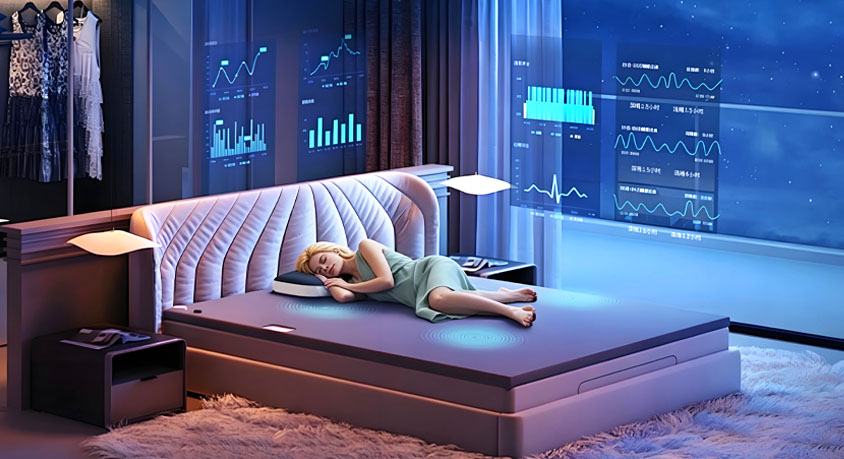
Last night, while you were drifting into REM sleep, your mattress was diligently compiling a biometric dossier on your heart rate variability, respiratory patterns, and every toss and turn. This isn't just about "optimizing your rest"; it is a silent, ongoing deposition being recorded by a sensor-laden textile. Most consumers believe their sleep data is a private medical asset, yet in the unregulated ecosystem of the Internet of Things, this information is increasingly leaking into the hands of data brokers and insurance underwriters. We have invited a high-fidelity snitch into our bedrooms under the guise of "wellness," transforming our most vulnerable hours into a harvestable commodity for corporate risk assessment.
E.g. :Your Gigabit Wi-Fi Feels Slow: The Hidden Home Network Speed Trap
- 1、The Exploitation of Biometric Sensors in the Modern Smart Bed
- 2、How Health Insurance Algorithms Weaponize Your Nightly Rest
- 3、The Failure of Current IoT Privacy Protocols in the Domestic Sphere
- 4、Reclaiming Your Bedroom from the Algorithmic Panopticon
- 5、The Hidden Cost of the Frictionless Life
The Exploitation of Biometric Sensors in the Modern Smart Bed
The technical allure of the smart mattress lies in its ability to turn biological noise into actionable signals using ballistocardiography (BCG) and high-sensitivity pressure arrays. By analyzing the micro-vibrations of your pulse through the mattress layers, these devices generate a "sleep score" that feels like a helpful health metric. However, the commercial value of this data far exceeds its utility to the sleeper; it provides a direct window into long-term chronic disease indicators. When your mattress communicates via a proprietary Wi-Fi gateway to a central cloud server, you lose the ability to gatekeep who sees your physiological decline or your lifestyle irregularities.
The Vulnerability of Cloud-Synchronized Vitals
Unlike clinical hardware, consumer-grade sleep trackers often prioritize ease of use over robust encryption. This means your nightly respiratory rate—a key indicator of potential heart failure or sleep apnea—is frequently transmitted in formats that are easily intercepted or sold through "third-party partner" loopholes in the fine print of your user agreement.
How Health Insurance Algorithms Weaponize Your Nightly Rest
The transition from traditional actuarial tables to real-time biometric underwriting is the invisible engine driving the smart bedding industry. Insurance companies are no longer content with your self-reported habits; they want the raw, unvarnished data of your physical existence. By correlating your "sleep debt" with your premiums, these institutions can preemptively hike rates for individuals whose nocturnal data points to "high-risk" behavior. This creates a digital caste system where those who cannot afford—or refuse to wear—the digital shackles of 24/7 monitoring are penalized with higher costs, effectively making privacy a luxury tax on the middle class.
The De-anonymization of "Aggregated" Sleep Trends
Data brokers often claim that your sleep metrics are "anonymous," but the temporal patterns of your rest are as unique as a fingerprint. By cross-referencing your mattress data with your smartphone’s GPS and purchase history, algorithms can reconstruct your identity with terrifying accuracy, rendering "anonymization" a meaningless marketing term.
The Failure of Current IoT Privacy Protocols in the Domestic Sphere
The industry’s reliance on the "Privacy by Policy" model rather than "Privacy by Design" is a fundamental betrayal of the user. Most smart home devices operate on a permissive data-outflow architecture where the device assumes the manufacturer has a permanent right to observe. To truly protect your digital sovereignty, the industry must shift toward local-only processing where biometric analysis happens on the "edge"—within the device itself—rather than on a remote server. Until the data remains trapped in the bedroom, your smart bed is nothing more than a surveillance node with a thread-count.
Reclaiming Your Bedroom from the Algorithmic Panopticon
Dismantling the digital landlord’s influence starts with a cold, pragmatic audit of every "connected" feature you actually use. If a mattress requires an internet connection to adjust its firmness, it is over-engineered for the purpose of data extraction. Real power in the age of the algorithm comes from "selective disconnection"—utilizing hardware that offers physical data-kill switches or opting for high-quality analog alternatives that don't report back to a mother ship. We must stop treating "smart" as a synonym for "better" and start recognizing it as a synonym for "monitored."
The Power of Local Network Isolation
For those who refuse to give up their sleep metrics, the only defense is to isolate these devices on a guest network with no external internet access. By forcing the device to talk only to a local, open-source hub, you can enjoy the "smart" features without the data leaking into the broader insurance ecosystem.
The Hidden Cost of the Frictionless Life
The convenience of a self-adjusting bed is a poor trade-off for the loss of biological autonomy. As IoT continues to colonize our private spaces, the boundary between "service" and "surveillance" will continue to blur until it disappears entirely. We are not just buying furniture; we are signing up for a lifelong audit conducted by machines that never sleep and never forget.
Protect your rest by remembering that the most sophisticated security system in your home isn't an app—it's the power to unplug the network.