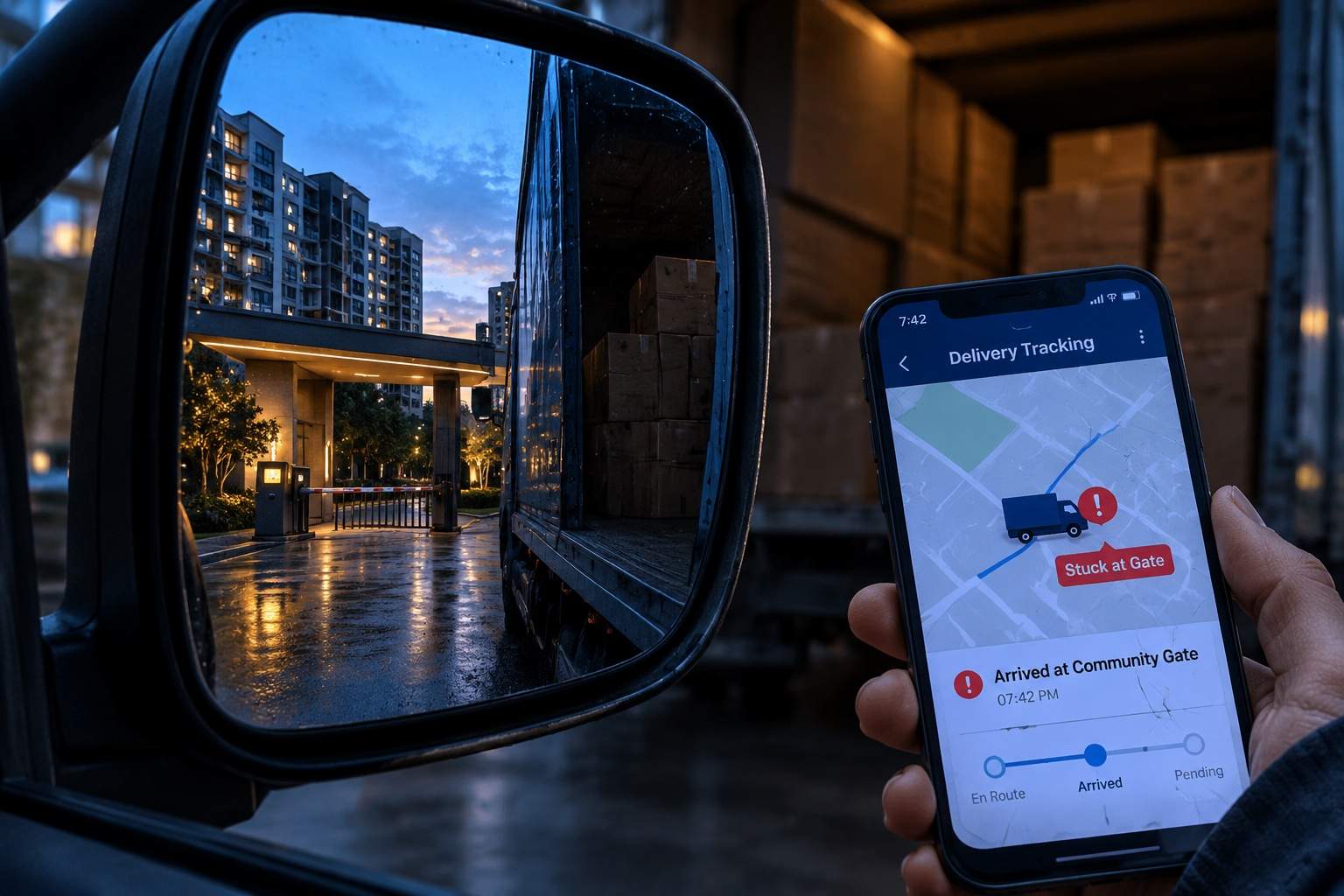
You are staring at a high-resolution map on your smartphone. A small blue truck icon is stationary, parked exactly at the entrance of your housing complex. According to the "Real-time Tracking" feature, your package is 200 meters away. Yet, the status remains "In Transit." Three hours pass. Then six. Your fresh groceries are theoretically within arm's reach, yet they remain trapped behind a digital wall.
E.g. :The Digital Necropolis: Is 'Virtual Preservation' a Historical Betrayal?
- 1、Why Smart Logistics Sensors Create a Transparent Trap for Frustrated Consumers
- 2、The Disconnect Between Vehicle GPS Tracking and Individual Parcel Identity
- 3、Cellular IoT Connectivity Limits in Dense Urban Micro-hubs
- 4、The Dark Reality of Automated Sorting and Manual Last Mile Friction
- 5、Why Efficiency Metrics Prioritize Fleet Utilization Over Individual Delivery Windows
- 6、Moving Beyond GPS to Precision Indoor Positioning for True Real-time Visibility
- 7、The Necessity of Mesh Networks in Residential Infrastructure
This is the GPS illusion. We have spent billions on IoT infrastructure to create the appearance of total transparency, but the "Last Mile" remains a digital black hole where data goes to die. For the consumer, it is an exercise in delivery anxiety. For the logistics giant, it is a calculated gap between data visibility and operational reality.
Why Smart Logistics Sensors Create a Transparent Trap for Frustrated Consumers
The primary business value of IoT in logistics was never to give you peace of mind. It was designed to reduce "Where Is My Order" (WISMO) calls. By providing a map, companies offload the psychological burden of waiting onto the consumer. If you can see the truck, you are less likely to clog the customer service lines, even if that truck isn't moving toward your door.
The technology serves the enterprise first. Real-time telemetry allows fleet managers to monitor fuel efficiency, driver behavior, and route optimization. The "Real-time Tracking" you see is often a byproduct—a sanitized version of raw data designed to manage your expectations rather than fulfill them.
The Disconnect Between Vehicle GPS Tracking and Individual Parcel Identity
The core of the problem lies in what is actually being tracked. In most logistics chains, the IoT sensor is attached to the vehicle, not the individual parcel. When you see that icon on your screen, you aren't tracking your box; you are tracking a three-ton van carrying three hundred other boxes.
Cellular IoT Connectivity Limits in Dense Urban Micro-hubs
GPS signals require a clear line of sight to satellites. Once that delivery truck enters a high-rise complex, a "canyon" of concrete, or an underground loading bay, the precision vanishes. The system often resorts to "Last Known Position" or cell-tower triangulation, which can be off by hundreds of meters, placing the truck at your door when it is actually two blocks away.
Even with LTE-M or NB-IoT connectivity, the handoff between the vehicle's gateway and the regional sorting center's local area network (LAN) creates a data lag. This lag is where your package disappears. The truck has "arrived" at the hub's geofence, but the physical unloading process hasn't been scanned into the system.
The Dark Reality of Automated Sorting and Manual Last Mile Friction
Logistics companies use automated sorting belts equipped with high-speed RFID overhead readers to process thousands of items per hour. This stage is hyper-efficient and generates clean data. However, the moment a human courier picks up your package to walk it to your apartment, the digital thread often snaps.
Why Efficiency Metrics Prioritize Fleet Utilization Over Individual Delivery Windows
From a systems engineering perspective, it is more "efficient" for a driver to park in one spot for four hours and deliver fifty packages on foot than to drive to each specific door. The IoT data shows the truck is stationary. The system records this as "On Schedule."
The industry faces a massive implementation gap: the cost of tagging every single parcel with an active, disposable IoT tracker is currently too high. Instead, we rely on passive scans at specific checkpoints. If your package sits at the bottom of a pile in the van, it hasn't been "seen" by the driver's handheld scanner yet, keeping the status in a state of digital limbo despite its physical proximity.
Moving Beyond GPS to Precision Indoor Positioning for True Real-time Visibility
To close this gap, the industry must shift from vehicle-centric tracking to item-level intelligence. This requires a transition to low-cost Bluetooth Low Energy (BLE) tags or Ultra-Wideband (UWB) for centimeter-level precision.
The Necessity of Mesh Networks in Residential Infrastructure
Solving the "Last Mile" requires more than just better sensors on the trucks; it requires the environment itself to be smart. If housing estates integrated localized IoT mesh networks, the package could "check-in" to the building’s infrastructure the moment it passes the gate. This would eliminate the dependency on the driver's manual scan and provide true end-to-end visibility.
The high-tech transparency we are sold today is a facade built on fragmented data. Until the sensor moves from the truck's dashboard to the package's cardboard, that little blue icon on your map will remain nothing more than a digital sedative for the anxious consumer.
The "Last Mile" isn't a distance problem; it's a data granularity problem. We are tracking the forest when we need to be tracking the trees.