The recent discovery of an extensive ancient necropolis beneath a bustling city center has presented modern society with an acute historical paradox. As the demands of urban development clash with the imperative to understand and preserve our past, a radical "digital twin" solution has emerged, promising to clear the site for construction in months rather than years. This technologically dazzling proposition, championed by developers and an increasingly tech-focused industry, offers a seductive vision of preservation through data, yet it forces us to confront an uncomfortable truth: are we inadvertently sacrificing the irreplaceable depth of our history for the sake of speed and virtual spectacle?
E.g. :Why your premium flagship CMOS sensor fails to capture life while mid-range hardware wins
- 1、The Allure of the Digital Twin in Archaeological Sites
- 2、Beyond the Surface: The Limits of Non-Invasive Archaeology
- 3、Decoding Deep Time: Contextual Integrity and Primary Data
- 4、The Looming Digital Shackles: Data Dust or Enduring Legacy?
- 5、Balancing Progress and Preservation: Ethical Dilemmas in Archaeological Technology
The Allure of the Digital Twin in Archaeological Sites
An ancient necropolis, a silent city of the dead, has been unearthed, stalling a massive urban renewal project. Facing immense pressure from developers and the public, archaeological authorities are being offered a seemingly elegant solution: a consortium proposes deploying cutting-edge non-invasive methods to create a comprehensive 3D digital model of the entire site. This vision, powered by digital twin heritage technology, promises a "virtual excavation," allowing limited physical recovery only in critical, targeted zones.
The technologies at play are impressive and undeniably powerful. Ground-penetrating radar (GPR) can map subterranean structures by sending radar pulses into the ground and analyzing reflections, revealing buried walls and tombs without disturbing a single grain of soil. LiDAR, or Light Detection and Ranging, uses pulsed lasers to create highly accurate 3D maps of surfaces, capturing every nuance of a site’s topography and any exposed features. Combined with photogrammetry, which stitches together thousands of high-resolution images into detailed 3D models, these tools generate an unprecedented wealth of spatial data. Furthermore, AI predictive modeling sifts through this vast dataset, identifying patterns and anomalies that might indicate significant finds, guiding virtual explorers to potential points of interest. This fast-track approach aims for efficient, in-situ preservation, minimizing disruption while maximizing digital documentation.
Beyond the Surface: The Limits of Non-Invasive Archaeology
While the promise of rapid data acquisition and minimal site disturbance is compelling, the foundational principle of archaeology has long rested on meticulous, often destructive, physical excavation. Traditional archaeology is not merely about finding objects; it is about understanding their relationships, their context, and the stories embedded in the soil layers and spatial arrangements. These layers, known as stratigraphy, are like the pages of a book, where each artifact's position, orientation, and association with other finds provide crucial clues to chronological sequences, social practices, and environmental conditions.
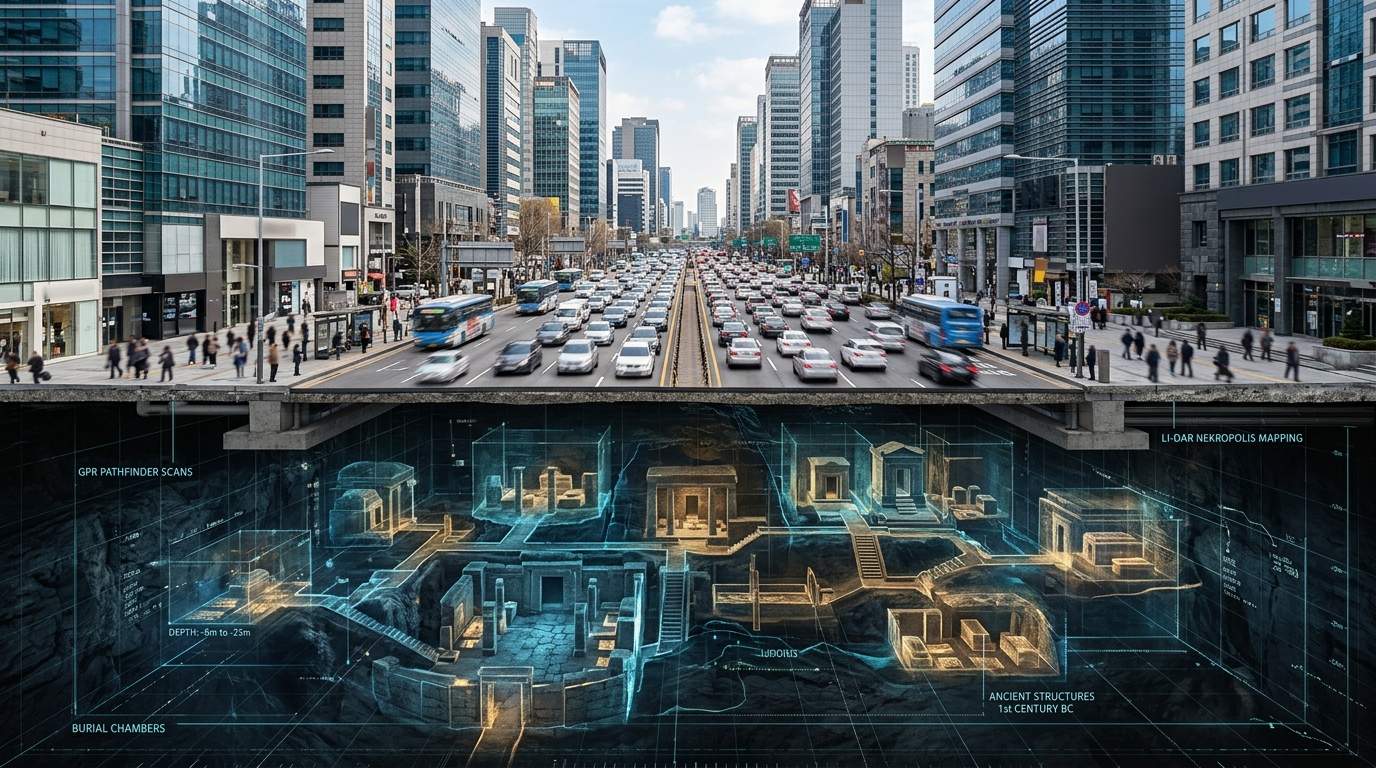
The very act of physical excavation, though irreversible, is what allows archaeologists to observe these fine-grained contextual details that non-invasive archaeology simply cannot capture. For instance, the subtle traces of a wooden coffin's decay, the orientation of a skeletal hand clutching a specific funerary offering, or the chemical residue on a pottery shard indicating its original contents – these are forms of primary data that can only be uncovered through careful, hands-on recovery. Relying solely on remote sensing risks turning complex historical narratives into a series of beautiful but ultimately superficial digital snapshots, missing the deeper, richer story.
Decoding Deep Time: Contextual Integrity and Primary Data
The true value of an archaeological site lies not just in its individual artifacts, but in the intricate web of relationships between them. This concept, known as contextual integrity, is paramount. Imagine discovering a coin: knowing it's Roman is one thing, but understanding where it was found – within a particular burial alongside specific pottery, or under a collapsed roof in a domestic dwelling – transforms it from a mere object into a historical data point illuminating trade routes, social status, or even a specific moment in time.
Primary data, gathered through traditional excavation, provides this irreplaceable context. It involves physically removing layers, meticulously documenting each find's precise coordinates, and analyzing soil changes, biological remains, and architectural elements in their original positions. These details, once disturbed, are gone forever. A digital twin, no matter how detailed, is a secondary representation, a model derived from the primary physical reality. It can show where things are, but it struggles to convey the subtle, multi-sensory information inherent in the act of discovery itself – the texture of the earth, the smell of decay, the fragile interdependence of objects and their surroundings.
The Irreducible Value of Material Evidence
To truly understand an ancient culture, we need to touch, analyze, and interpret its material remains in their original state. The subtle marks of ancient tools on stone, the composition of ancient pigments, the microscopic pollen grains trapped in an burial pit – these are the irreducible details that digital models can only approximate, never fully replicate.
The Looming Digital Shackles: Data Dust or Enduring Legacy?
While the digital twin promises a form of preservation, it also introduces a new set of vulnerabilities. What happens when the software used to interpret these intricate 3D models becomes obsolete? What about the sheer volume of data, and the cost of its long-term storage and curation? We risk creating vast archives of "data dust" – invaluable information locked behind outdated formats, inaccessible platforms, or simply forgotten in the digital ether.
This dependency on specific technologies, proprietary software, and continuous funding for digital maintenance creates what could be seen as "digital shackles" around our historical understanding. Future archaeologists might find themselves with an abundance of digital representations, yet lack the means to truly engage with them, or to verify their interpretations against the original, tangible evidence that was sacrificed. This raises profound questions about the long-term viability and accessibility of digitally preserved heritage.
Balancing Progress and Preservation: Ethical Dilemmas in Archaeological Technology
The tension between rapid development and thorough preservation is not new, but advanced archaeological technology intensifies the ethical dilemmas in archaeological excavation. The speed and cost-effectiveness offered by digital solutions are powerful motivators for developers and even for cash-strapped heritage institutions. However, prioritizing these factors above the nuanced, physically recovered contextual understanding of our shared past presents an asymmetry of interests that demands careful scrutiny.
Is maximizing digital data acquisition and virtual preservation a truly equivalent or acceptable substitute for the irreplaceable primary data gathered through traditional methods? Or are we, in our haste, creating a historical narrative that is wide but shallow, visually stunning but contextually compromised? The challenge lies in finding a judicious balance, where cutting-edge technology enhances, rather than replaces, the profound insights derived from hands-on archaeological practice. This might mean highly targeted physical excavations informed by remote sensing, or innovative ways to integrate both approaches to achieve a more complete understanding.
Redefining "Preservation" in the Digital Age
The very definition of "preservation" is evolving. Is it the safeguarding of physical remains in situ, or the meticulous capture and endless replication of data about those remains? Our decisions today will dictate not only what we preserve, but how future generations will connect with their deep history.
The choice before us is not merely a technical one; it is a profound ethical decision about the nature of our relationship with the past. While technology offers unprecedented tools to document and analyze, we must remain vigilant against the seductive illusion that a digital echo can fully replace the primary, physical voice of history. To truly honor the silent inhabitants of the necropolis, and to empower future archaeologists, we must ensure that our pursuit of digital spectacle does not inadvertently lead to the burial of deep, irreplaceable historical understanding under layers of data dust.