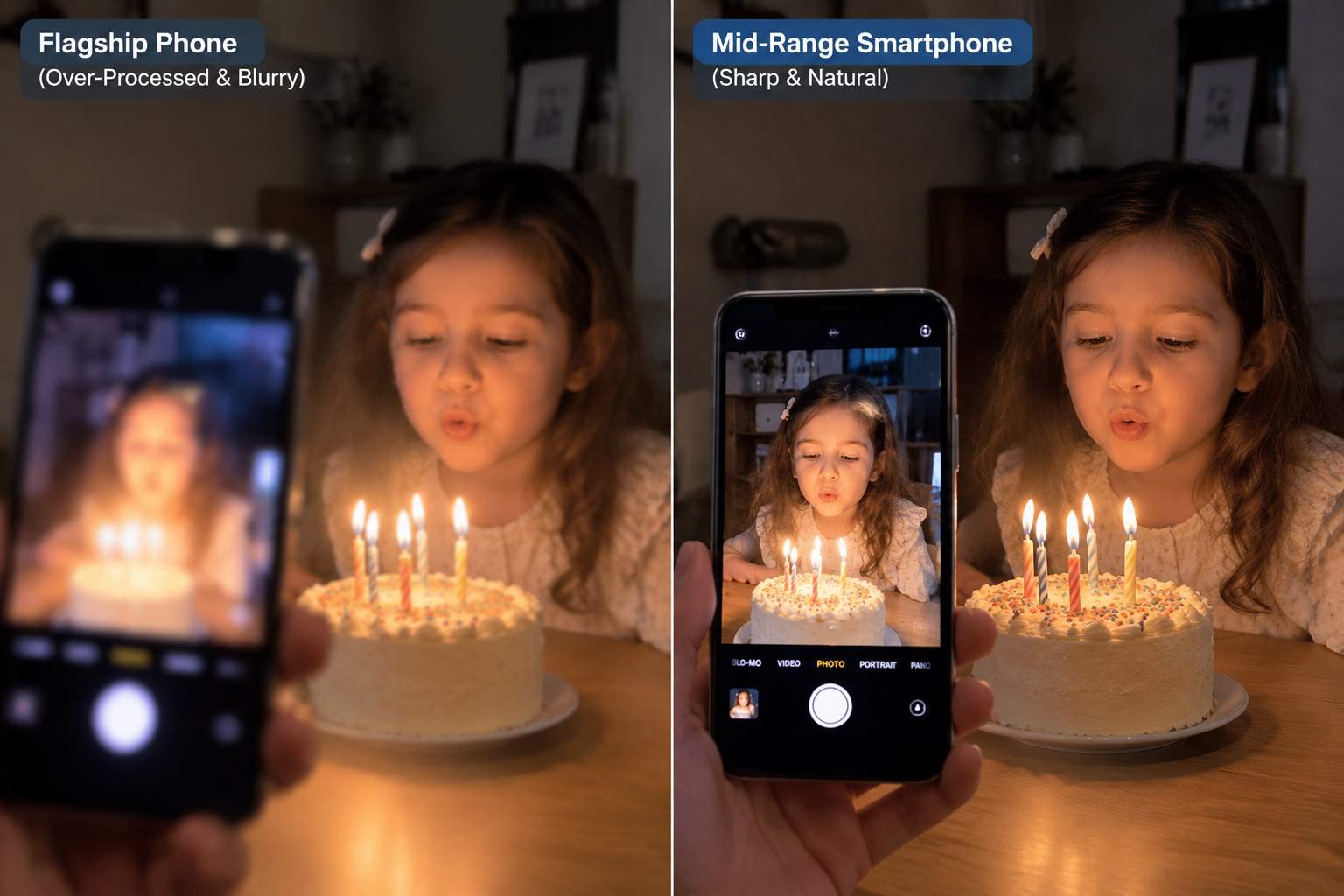
You are at a dimly lit birthday party. Your child is about to blow out the candles. You pull out your $1,200 "Ultra" flagship, confident in its massive lens. You press the button. The screen freezes for a microsecond of "processing," and by the time the shutter clicks, the moment is gone. You are left with a blurry smudge of light and a child who has already moved on. Meanwhile, your cousin’s $500 mid-range phone snapped a sharp, clean shot instantly.
E.g. :Why Seamless User Experience Isn't Your Friend: The Dark Patterns Draining Your Digital Wallet
- 1、How massive CMOS sensor size creates a focus bottleneck
- 2、Why high ISP computational power leads to shutter lag
- 3、Optical image stabilization and the weight of luxury
- 4、Performance modules and the reality of daily use
- 5、Finding the efficiency sweet spot for your wallet
This is the dirty secret of the modern hardware industry. We have reached a point where "more" actually means "slower." Manufacturers are selling you specifications that look great on a spreadsheet but fall apart when a toddler starts moving.
How massive CMOS sensor size creates a focus bottleneck
The race for the 1-inch CMOS sensor has turned phones into heavy bricks. While a larger sensor technically catches more light, it also creates a razor-thin depth of field. In a laboratory, this creates beautiful background blur. In a living room with a moving target, it means the phone struggles to find the focus point.
When the sensor is huge, the lens elements must move a greater physical distance to achieve focus. This mechanical movement takes time. In the world of high-end optics, we call this hunting. Your $1,200 device is literally over-thinking the shot while life passes it by.
The physics of lens weight and movement speed
A flagship phone often carries a lens assembly that is three times heavier than a mid-range counterpart. Moving that glass requires more power and more time. Mid-range devices use smaller, lighter lens stacks that can snap into focus almost instantly because they have less physical mass to shift.
Why high ISP computational power leads to shutter lag
Flagship phones are obsessed with making every photo look like a movie poster. The moment you tap the shutter, the Image Signal Processor (ISP) begins a marathon. It captures 10 to 15 frames, merges them for dynamic range, applies AI noise reduction, and sharpens the edges.
This creates a massive "shutter lag" where the image you see on the screen is not the image the phone actually saves. The "brain" of the phone is so busy painting a masterpiece that it forgets to capture the actual second you clicked.
The wax figure effect in AI processing
Because flagship sensors capture so much raw data, the AI often over-compensates to manage the noise. This results in the "wax figure" look on human skin. Mid-range phones, with their simpler ISPs, often perform less aggressive processing, leaving skin textures looking like actual skin rather than a smoothed-out plastic doll.
Optical image stabilization and the weight of luxury
Optical Image Stabilization (OIS) is essential for night shots, but flagships have turned it into a heavy complex of magnets and motors. This adds significant weight to the top of the device, making it top-heavy and awkward to hold with one hand during quick snapshots.
A $500 device usually prioritizes ergonomics. It is thinner, lighter, and easier to whip out of a pocket. In the time it takes you to balance your 240-gram flagship "Ultra" phone, the mid-range user has already finished their video and put the phone away.
Performance modules and the reality of daily use
When we look at the screen and battery life, the "Ultra" flagship often shoots itself in the foot. These devices use 4K or high-resolution LTPO panels that drain the battery significantly faster just to show you pixels your eyes cannot even distinguish at a normal viewing distance.
Screen and battery efficiency comparisons
A mid-range phone typically uses a 1080p OLED screen. Data shows that at a 6-inch screen size, the power savings of a 1080p panel over a 1440p panel can extend daily battery life by 15-20%. For a professional on the move, that extra 2 hours of "on-screen time" is far more valuable than a few extra pixels in a menu icon.
System software and bloatware overhead
Flagship phones are often laboratories for "experimental features" that clog the system software. Every time you open the camera, dozens of background processes for "scene recognition" or "object tracking" spin up. Mid-range devices usually run a leaner version of the OS, leading to a snappier, more predictable user experience.
Finding the efficiency sweet spot for your wallet
If you are a professional landscape photographer who uses a tripod, buy the $1,200 flagship. The large CMOS sensor will reward your patience. But if you are a parent, a traveler, or someone who just wants to document life as it happens, the flagship is a burden.
The mid-range market has become the "efficiency sweet spot." You get 90% of the usable technology at 40% of the price, without the mechanical and computational delays that ruin spontaneous memories. Technology should serve the moment, not force the moment to wait for the technology.