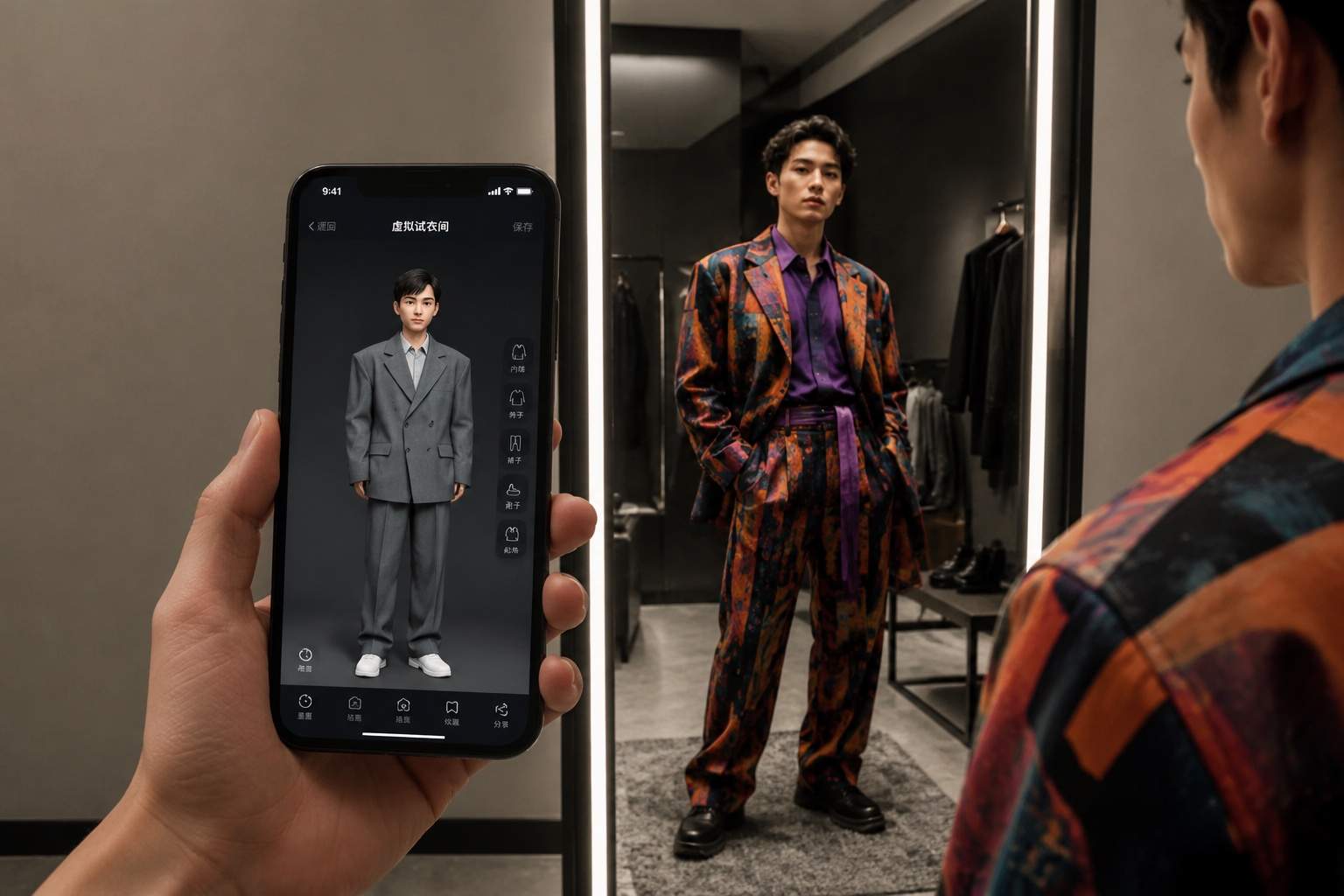
You stand before your smartphone, expecting a digital mirror that unlocks a more daring version of yourself for an upcoming wedding, yet the technology seems to have other plans. Instead of the architectural, form-fitting silhouette you envisioned, the high-end shopping app’s 3D Virtual Try-On (VTO) feature nudges you toward a succession of boxy, oversized blazers and "relaxed-fit" trousers that feel more like a uniform than a fashion statement. This is not a glitch in the rendering engine, but rather a deliberate alignment of code that prioritizes corporate logistics over your personal aesthetic.
E.g. :Why Precision IoT Greenhouse Produce Spoil Faster in Smart Home Refrigerators
- 1、The High-Tech Facade of 3D Virtual Try-On and NeRF Accuracy
- 2、The Hidden Incentive: Designing for Low-Return Probability
- 3、How GANs and Latent Space Sanitize Human Individuality
- 4、Anthropometric Data Privacy and the Price of Digital Fitting
- 5、Breaking the Digital Shackles of Algorithmic Aesthetic
The High-Tech Facade of 3D Virtual Try-On and NeRF Accuracy
Neural Radiance Fields, or NeRF, have revolutionized how we perceive digital objects by allowing algorithms to synthesize complex 3D scenes from a handful of 2D images. In the context of fashion, this technology promises a hyper-realistic representation of how fabric drapes over the unique topography of the human body. When you rotate your avatar, the way light hits the silk or the way a seam pulls should, theoretically, provide a level of "fit certainty" that traditional size charts never could.
The sophistication of these models creates a sense of trust, leading users to believe the AI is an objective arbiter of style. By capturing your likeness through a series of photos, the system builds a high-fidelity volumetric model that feels deeply personal and scientifically accurate. However, the high-resolution texture of the garment often masks a more fundamental shift in how the industry views the consumer’s body: as a data point to be managed rather than an identity to be expressed.
The Hidden Incentive: Designing for Low-Return Probability
The primary driver behind the sudden ubiquity of VTO tools is not a newfound commitment to "inclusive design," but a desperate need to curb the astronomical costs of return logistics. For major e-commerce players, returns represent a multibillion-dollar drain on margins, often driven by "fit frustration" where a garment simply does not look like the photo. Consequently, the underlying Computer Vision models are optimized for a specific metric: the "Low-Return Probability" silhouette.
The Rise of the "Safe-Fit Ghetto"
Algorithms are inherently conservative because the cost of a "miss"—a return—outweighs the benefit of a "hit" on a daring, complex garment. To mitigate this risk, the AI’s Latent Space—the mathematical map of all possible garment configurations—is heavily weighted toward looser fits and forgiving fabrics. If the software recommends a boxy cut, the likelihood of that garment failing to close or pinching at the waist drops to near zero, effectively trapping the consumer in a "Safe-Fit Ghetto."
By steering users toward silhouettes that are "mathematically guaranteed" to fit a wide range of body types, the algorithm silently kills individual expression. The bold, avant-garde pieces that require precision tailoring are often "de-emphasized" or rendered with less accuracy, as the model struggles to predict their behavior on non-standardized bodies. This creates a feedback loop where consumers only buy what the AI can safely predict, slowly eroding the diversity of the physical fashion landscape.
How GANs and Latent Space Sanitize Human Individuality
Generative Adversarial Networks (GANs) are the workhorses that allow digital clothing to "merge" with your body scan, yet they operate on a principle of normalization. In the process of mapping a garment onto your digital twin, the GAN often smooths out the very "imperfections" or unique physical traits that define personal style. This "Latent Space modeling" essentially averages out your physique, making you appear more like the training data the model was built upon.
The result is a sanitized version of reality where every user begins to look like a variation of a singular, optimized template. When the AI "imagines" how a dress fits you, it isn't just looking at your measurements; it is comparing you to thousands of other data points and choosing the path of least resistance. This digital homogenization ensures that the clothes look "fine" on everyone, but truly "great" on no one, sacrificing the spark of personal style for the safety of the mean.
Anthropometric Data Privacy and the Price of Digital Fitting
To participate in this new era of personalized commerce, users are surrendering highly sensitive biometric data, known as anthropometric data, often without fully understanding its long-term value. Your body measurements, posture, and even your gait are captured by these apps to create the "perfect" fit. While this data is ostensibly used to improve your shopping experience, it also forms a permanent digital blueprint of your physical self that remains in corporate hands.
The Asymmetry of Interest in Biometric Harvesting
There is a profound asymmetry between the convenience offered by VTO and the sensitivity of the data being collected. While you might save ten minutes on a return, the brand gains a persistent, granular understanding of your biological changes over time. This data is far more intimate than a browsing history; it is a record of your physical evolution, which could theoretically be used for everything from targeted health insurance adjustments to more invasive forms of behavioral tracking.
Breaking the Digital Shackles of Algorithmic Aesthetic
The promise of AI democratization in fashion was supposed to be about breaking down the barriers of the traditional runway, yet we find ourselves being herded into a new kind of conformity. We must recognize that the "Virtual Stylist" is, in reality, a digital gatekeeper designed to protect profit margins by narrowing the scope of what we choose to wear. When the algorithm suggests a "safe" fit, it is not a compliment to your body, but a shield for the company’s bottom line.
True aesthetic empowerment requires us to look past the high-fidelity renderings of NeRF and the smooth transitions of GANs. We should treat VTO as a logistical tool rather than a stylistic compass, maintaining a healthy skepticism of any technology that claims to know our "style" while simultaneously trying to minimize the cost of our existence. The future of fashion should be dictated by the wearer’s courage, not by a model’s fear of a return shipping label.
Ultimately, the digital shackles of the "Safe-Fit Ghetto" are only as strong as our willingness to follow the prompt. By reclaiming the right to the "risky" fit and demanding transparency in how our biometric data is used, we can ensure that AI serves as a tool for expansion rather than a mechanism for architectural boredom.