Walking into an office used to be simple: find a desk, sit down, and work.
E.g. :Self-Driving's Unseen Cost: Is Level 5 Autonomy a Liability Loophole?
- 1、Smart Office Technology Is Changing How Workplaces Operate
- 2、IoT Workplace Automation Has a Blind Spot
- 3、Smart Meeting Rooms Solve a Real Everyday Problem
- 4、Indoor Air Quality Is Where Smart Offices Get More Interesting
- 5、The Real Cost of Smart Office Technology
- 6、A Smart Office Should Know When Not to Measure
Now, some workplaces can detect which desks are occupied, monitor meeting-room usage, adjust lighting automatically and measure indoor air conditions.
The promise is straightforward. IoT workplace technology should reduce wasted space, improve energy efficiency and make offices easier to manage.
But there is an awkward question behind all those sensors: if a company can measure almost everything happening inside an office, does that actually make the workplace better?
Smart Office Technology Is Changing How Workplaces Operate
Commercial buildings consume substantial amounts of energy, making heating, cooling and lighting obvious targets for efficiency improvements.
Occupancy-based systems can use sensors to determine whether spaces are being used and adjust building systems accordingly.
Instead of cooling an entire floor at maximum capacity throughout the day, a building management system can respond to actual occupancy patterns.
That is where IoT has a practical advantage: it turns physical activity into data that building systems can use.
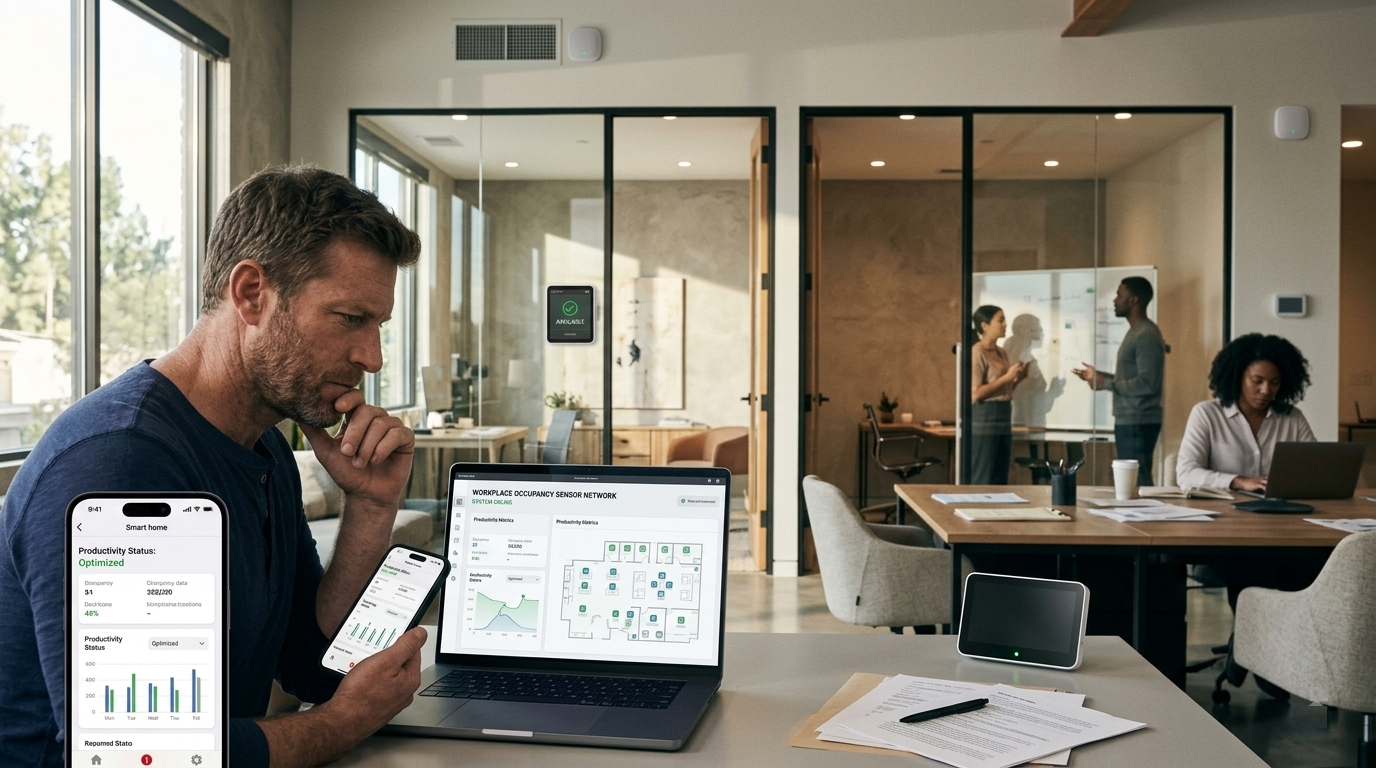
Occupancy Sensors Are More Useful Than They Sound
An occupancy sensor does not need to know who is sitting at a desk.
It can simply detect whether an area is being used and send that information to a building management system.
The difference matters. Measuring space usage can improve building efficiency without necessarily requiring detailed employee tracking.
IoT Workplace Automation Has a Blind Spot
The technology becomes less convincing when companies start measuring productivity instead of simply managing buildings.
A desk sensor can tell whether someone is present. It cannot reliably tell whether that person is solving a difficult problem, attending a virtual meeting, reading research or simply thinking.
Presence is measurable. Productivity is much harder to define.
Treating the two as interchangeable can turn useful workplace data into misleading performance signals.
More Data Does Not Mean Better Management
Managers may discover that certain meeting rooms are rarely occupied while others are constantly booked.
That information can help redesign office space.
But collecting more employee-related data does not automatically produce better decisions. Poorly defined metrics can create unnecessary monitoring while telling management very little about actual work quality.
Smart Meeting Rooms Solve a Real Everyday Problem
Meeting rooms are one of the easiest places to see the commercial value of IoT.
Employees waste time searching for available rooms, while reserved spaces can remain empty when meetings are canceled.
Smart room displays and occupancy sensors can show whether a room is actually being used and help organizations understand demand.
The benefit is not futuristic. It is simply better utilization of expensive office space.
Empty Rooms Are an Expensive IoT Opportunity
For companies operating large offices, even small improvements in space utilization can matter.
Instead of adding more rooms, organizations can use occupancy data to understand how existing space is actually being consumed.
That can influence everything from room scheduling to office design.
Indoor Air Quality Is Where Smart Offices Get More Interesting
Temperature is only one part of workplace comfort.
IoT sensors can also monitor factors such as carbon dioxide concentration, temperature and humidity.
Carbon dioxide levels are often used as an indicator of ventilation conditions in occupied spaces. When levels rise, building operators can investigate whether ventilation needs adjustment.
The technology does not magically create better air. It gives facility teams information they previously had to estimate or measure manually.
Sensors Turn Invisible Problems Into Measurable Ones
A room that feels “stuffy” does not provide much information to a facilities manager.
A sensor reading can.
That shift from subjective complaints to measurable building conditions is one of the strongest arguments for workplace IoT.
The Real Cost of Smart Office Technology
Installing sensors is only the beginning.
Companies also need reliable connectivity, device maintenance, data management and clear rules about how workplace information is used.
Privacy is particularly important when systems move beyond building management into employee monitoring.
A company may technically be able to collect detailed behavioral data. That does not mean collecting it is necessary.
The smartest deployment is often the one that gathers the minimum information required to solve a specific operational problem.
A Smart Office Should Know When Not to Measure
IoT can make offices more efficient, but efficiency should not become an excuse for endless monitoring.
Occupancy sensors can help reduce wasted space. Smart HVAC controls can improve building operations. Air-quality sensors can identify problems that people cannot easily see.
Those are useful applications because the data has a clear purpose.
A smart office should not be judged by how much data it collects. It should be judged by whether that data solves a real problem without creating a bigger one.