That familiar tech itch, right? Your 2-3 year old phone occasionally stutters, the battery barely makes it to lunchtime, or your laptop takes a few extra seconds to load. You start browsing the latest models, seeing impressive specs and review scores, feeling that familiar pull – and pressure – to upgrade. But then you look at the astronomical price tag and wonder: does that marginally faster processor or slightly better camera truly justify breaking the bank again?
E.g. :Free Sun, Costly Power? The "Green Premium" and Grid Reliability.
- 1、The Myth of Must-Have Flagship Performance
- 2、Battery Life and Storage: Your Real Upgrade Pain Points
- 3、Camera Wars: More Megapixels, Better Photos? Not Always.
- 4、The Value Proposition: Mid-Range Magic and Older Flagships
- 5、Your Tech's Longevity: A Mindset Shift
As someone who’s been neck-deep in hardware for decades, I’ve seen this cycle repeat more times than I can count. The market shouts "NEW! FASTER! BETTER!" at us every year, pushing the narrative that anything less than the absolute latest is somehow "obsolete." But let's talk real talk. Are you really upgrading for a better experience, or just falling for clever marketing and the fear of missing out? My aim isn't to sell you anything, but to be your efficiency mentor, helping you find the tech that genuinely serves you, not the other way around.
The Myth of Must-Have Flagship Performance
For years, the gospel has been clear: you need the newest flagship with the absolute best processor, RAM, and storage to ensure optimal performance and "future-proof" your tech. But let’s pull back the curtain on this widely accepted "common sense." How much real-world difference does a 15-20% faster chip make for your everyday tasks? For 90% of users, the answer is often "barely perceptible."
Think about it: are you editing 8K video on your phone daily? Running complex CAD simulations on your laptop while commuting? Most of us are scrolling social media, checking emails, watching Netflix, making video calls, and typing documents. A device from two or three years ago, particularly a mid-range or a slightly older flagship, can handle these tasks with surprising ease. Benchmarks show raw power, but your finger on the screen often tells a different story.
Diminishing Returns on Processor Power
Processors (CPUs) in consumer devices have achieved incredible speeds. The performance gains we see today are incremental, not revolutionary, for general usage. A high-end smartphone chip from 2021 compared to a 2024 model might show a 20-25% benchmark lead for the newer chip. But in your hand, opening ten apps simultaneously, the 2021 model might take 3 seconds, while the 2024 model shaves off a mere 0.2 seconds. Is that 0.2 seconds worth $1000 or more? For most, the answer is a resounding "no." The performance ceiling for common tasks was hit years ago.
Battery Life and Storage: Your Real Upgrade Pain Points
Where older devices actually show their age isn't usually in raw processing power, but in two very tangible areas: battery life and storage capacity. Batteries degrade over time, losing their ability to hold a charge. This is a chemical reality, not a planned obsolescence conspiracy (though it certainly feels like one sometimes!).
If your phone drains by early evening, a battery replacement often costs a fraction of a new device – typically $50-$100 – and can extend your phone’s usable life by another 1-2 years. It’s like replacing worn tires on a perfectly good car. As for storage, running out of space, especially with ever-growing photo and video libraries, is a genuine annoyance. However, affordable cloud storage subscriptions, external drives for laptops, or simply better file management are often far more economical solutions than purchasing an entirely new gadget. Many new devices still offer paltry base storage, pushing you towards pricier tiers anyway.
Camera Wars: More Megapixels, Better Photos? Not Always.
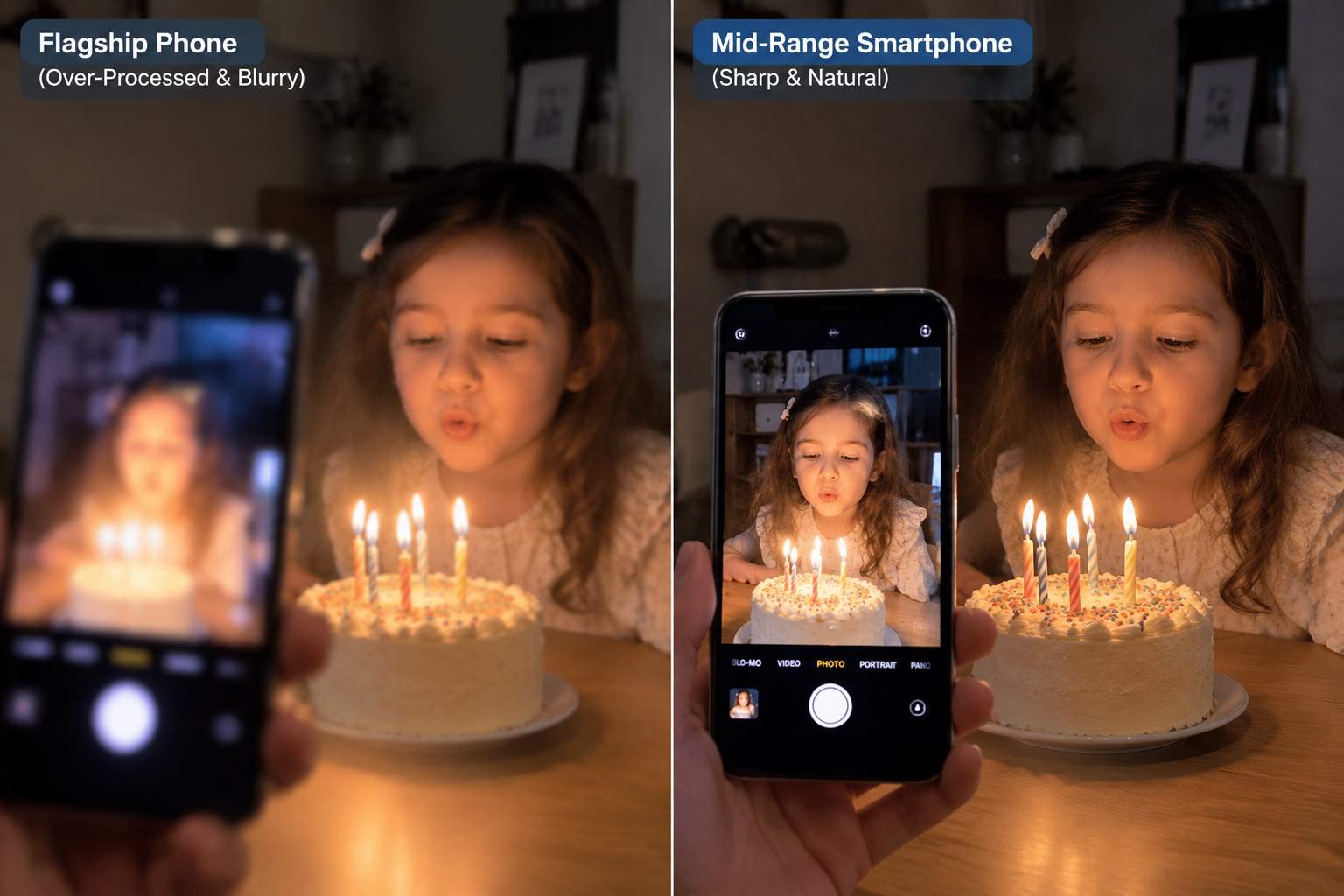
Camera technology is a huge selling point for new flagships. They boast incredible low-light performance, insane zoom capabilities, and cinematic video modes. And yes, the cutting edge is impressive. However, for the average user, a 2-3 year old flagship camera still produces excellent results for social media, family photos, and video calls. Unless you're a professional photographer or an avid enthusiast pixel-peeping every shot, the difference between a 2022 flagship camera and a 2024 one in broad daylight is often negligible to the naked eye.
Imagine snapping a picture of your dinner at a restaurant. A mid-range phone from 2022 with decent software processing can still capture a perfectly clear, shareable image. The marginal improvements rarely translate into a "must-have" for everyday memories.
Software's Magic Touch in Photography
It’s not just about the megapixel count or lens array anymore; software algorithms do much of the heavy lifting in modern mobile photography. Features like HDR, portrait mode, and night mode are heavily reliant on computational photography. Often, older devices receive software updates that improve their camera performance, leveraging the existing hardware more effectively. This means your "good enough" camera might actually get better over time, without you spending a dime on new hardware.
The Value Proposition: Mid-Range Magic and Older Flagships
The true heroes of today's tech landscape aren't always the shining flagships. The mid-range market, for mobile phones, laptops, and tablets, has matured dramatically. Today's mid-range devices often offer 80-90% of the flagship experience at 40-60% of the price. We're talking excellent screens, solid performance for daily tasks, and respectable cameras. Many mid-range phones now outperform old flagships in areas like battery life, thanks to optimized chips and larger capacities.
And then there's the unsung hero: the slightly older flagship. A 1-year or 2-year-old flagship, bought at a steep discount, offers incredible value. These were top-tier devices just recently and still deliver exceptional performance for years. This strategy is for the vast majority of users who prioritize practicality, budget, and sustainability over chasing the bleeding edge. It's not for extreme gamers or professional content creators needing the absolute peak of performance, but for everyone else, it's a golden ticket.
Your Tech's Longevity: A Mindset Shift
Ultimately, this isn't just about saving money; it's about a mindset shift. Instead of viewing your tech as a disposable fashion accessory, see it as a reliable tool. A good wrench doesn't need replacing every year just because a shinier one came out. By extending the life of your devices, you save money, reduce electronic waste, and alleviate the stress of constant upgrade pressure.
Your current laptop might be perfectly fine for remote work, online classes, and entertainment, saving you hundreds, if not thousands, that could be better spent on experiences, investments, or other life improvements. True obsolescence eventually hits (software support ends, critical components fail), but often, that point is far beyond the typical 1-2 year upgrade cycle. Re-evaluate your actual needs versus perceived needs driven by marketing. The real "upgrade" might just be changing your perspective, not your device.