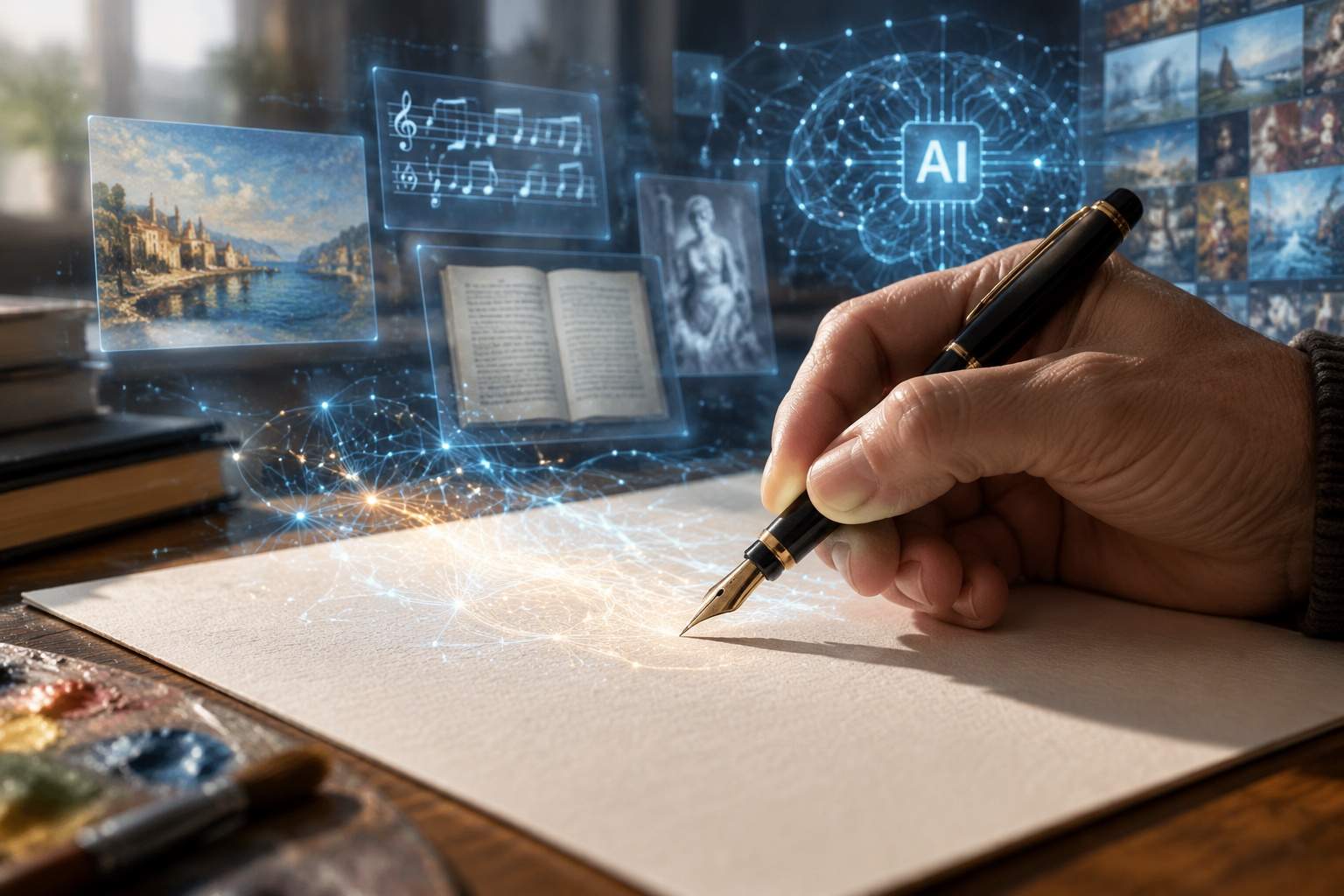
Imagine a future where the next chart-topping hit song, award-winning novel, or iconic painting is revealed to be 100% generated by a sophisticated AI. While impressive, a critical question emerges: Who truly owns this creation? More importantly, what happens to the millions of human artists whose past works—their entire creative legacies—were indiscriminately ingested as "training data" by these Generative AI systems, often without consent or compensation, only to be outcompeted by the very machines they helped build? This isn't a distant dystopia but a contemporary dilemma, as the rapid advancement of Generative AI creates an unprecedented intellectual property crisis, leaving human creators vulnerable and uncompensated.
E.g. :The Invisible Prison: Why Frictionless UX is Erasing Your Right to Choose
- 1、The Unseen Harvest: AI Training and the "Fair Use" Dilemma
- 2、Echoes of Originality: When Does Replication Become Plagiarism?
- 3、The Creator Economy Under Siege: Economic Disruption and Digital Shackles
- 4、Data Provenance and Compensation: Tracing the Algorithmic Lineage
- 5、Navigating the Future: Towards a Harmonized AI Copyright Framework
The Unseen Harvest: AI Training and the "Fair Use" Dilemma
The foundation of modern Generative AI—particularly Large Language Models (LLMs) and advanced image/audio synthesis—is the ingestion of vast datasets, frequently comprising copyrighted works. The burgeoning AI industry largely operates under the premise that this colossal data intake, essential for model training, falls comfortably under "fair use" doctrine. This legal interpretation, akin to how a human artist might study countless existing works to hone their craft, suggests that such algorithmic "learning" is transformative and does not constitute copyright infringement. This perspective prioritizes unhindered innovation, fostering rapid technological advancement and substantial profit for tech giants, often at the unacknowledged expense of original creators.
The "Transformative Use" Argument: A Legal Tightrope
At the heart of the fair use debate for AI training lies the concept of "transformative use." Legal frameworks traditionally consider use transformative if it adds new expression, meaning, or message to the original work, moving beyond mere reproduction. Proponents argue that an AI model, by learning patterns and generating entirely new outputs, fundamentally transforms its training data into something different. However, critics counter that if the AI's output too closely mimics the style or substance of its training data without significant alteration, it risks becoming derivative, thereby undermining the transformative claim and potentially infringing upon the original creator's rights. The complexity here arises because the "transformation" occurs not in a human mind but within a black box of billions of parameters, making intent and originality difficult to discern.
Echoes of Originality: When Does Replication Become Plagiarism?
The question of originality, long a cornerstone of copyright law, becomes deeply muddled in the age of AI-generated content. If an AI system, having processed millions of images by a particular artist, then produces a work stylistically indistinguishable from that artist's hand, is it a novel creation or an act of digital plagiarism? The distinction is crucial, as copyright protection is traditionally granted to original works of authorship fixed in a tangible medium. The algorithmic "learning" process, while complex, does not inherently confer originality in the human sense, prompting a re-evaluation of what originality means when a machine, not a human, is the primary "author."
Deconstructing Imitation: Style, Substance, and Source Material
Understanding whether AI output is truly original requires deconstructing the nature of algorithmic imitation. Is the AI merely replicating a recognizable style, which is generally not copyrightable, or is it reproducing protectable elements of specific works? The challenge lies in the "latent space" of these models, where stylistic commonalities and thematic structures are abstracted. When an AI generates a new piece, it might synthesize elements from thousands of sources, making direct attribution of infringement difficult but not impossible, especially if the output exhibits a strong resemblance to a specific copyrighted work or a distinctive collection of works. This blurs the line between inspiration, emulation, and outright appropriation.
The Creator Economy Under Siege: Economic Disruption and Digital Shackles
For millions of human artists, writers, musicians, and designers, the rise of Generative AI presents a direct and existential economic threat. Their creative legacies, often built over decades, are being used to train AI models that subsequently produce synthetic media, mimicking their styles and directly competing for commercial opportunities. This process, often conducted without consent or compensation, effectively turns human creativity into raw material for an industrial-scale content generation machine. The result is a profound disruption to the creator economy, where the value of original human work is diluted, and artists face the imposition of "digital shackles"—losing control over their intellectual property and their livelihoods in an increasingly automated landscape.
Data Provenance and Compensation: Tracing the Algorithmic Lineage
A critical missing piece in the current AI ecosystem is robust data provenance—the ability to accurately trace the origin and licensing status of every piece of data used in AI training. Without transparent and auditable records of training data, it becomes impossible to fairly compensate creators whose work contributes to AI models' capabilities. Implementing mechanisms for compensation, such as micro-payments or licensing schemes, for the use of copyrighted material in AI training is a complex but necessary step. This demands not only technological solutions for tracking data usage but also new legal frameworks that recognize and remunerate creators for their foundational contributions to AI development.
Navigating the Future: Towards a Harmonized AI Copyright Framework
The current legal frameworks for Intellectual Property (IP) and copyright are undeniably ill-equipped to address the complexities of AI model training, data provenance, and the evolving definition of "originality" in an era of computational creativity. Addressing this requires a multi-faceted approach involving collaboration between legal experts, technologists, and policymakers. Establishing clear guidelines for what constitutes "fair use" in AI training, mandating transparency in data sourcing, and exploring new models for creator compensation are essential steps. The goal must be to foster innovation in AI while simultaneously protecting the rights and livelihoods of human creators, ensuring that technological progress does not come at the cost of creative equity.
The profound questions raised by AI's interaction with copyright are not merely academic; they define the future relationship between technology and human creativity. As AI systems become increasingly sophisticated, the challenge is to forge a path that allows for algorithmic advancement without undermining the very human spirit of innovation it seeks to emulate.